Cessna Aircraft Company
Cessna A-37 Dragonfly,
or Super Tweet
Manufactured 1963–1975
First flight October 1964
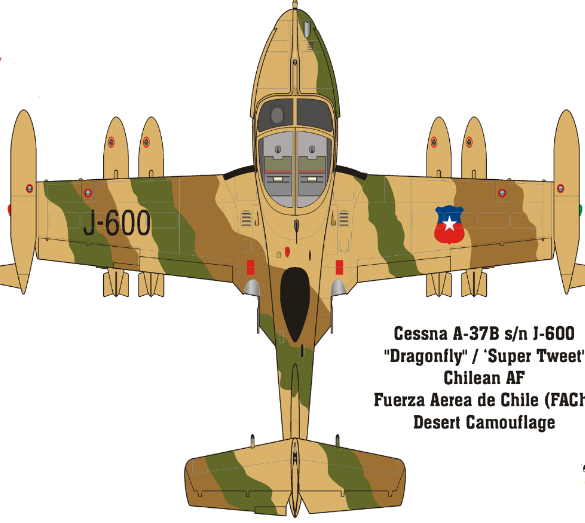

Cessna A-37 Dragonfly
Super Tweet
.jpg) |
|
| General information | |
|---|---|
| Type | Light ground-attack aircraft |
| National origin | United States |
| Manufacturer | Cessna |
| Status | Limited service in Central American and South American air forces |
| Primary users | United States Air Force (historical)Republic of Vietnam Air Force (historical) Chilean Air Force (historical) Peruvian Air Force |
| Number built | 577 |
| History | |
| Manufactured | 1963–1975 |
| First flight | October 1964 |
| Developed from | Cessna T-37 Tweet |
.
History Cessna Aircraft Company
Cessna A-37 Dragonfly,
or Super Tweet
Manufactured 1963–1975
First flight October 1964
The Cessna A-37 Dragonfly, or Super Tweet, is a jet-powered, light attack aircraft designed and produced by the American aircraft manufacturer Cessna.
It was developed during the Vietnam War in response to military interest in new counter-insurgency (COIN) aircraft to replace aging types such as the Douglas A-1 Skyraider. A formal United States Air Force (USAF) evaluation of the T-37 Tweet basic trainer for the COIN mission was conducted in late 1962, after which it was concluded that it could be modified to effectively perform the role. The attack-orientated A-37 was directly derived from the T-37, roughly doubling in both all-up weight and engine thrust to permit considerable quantities of munitions to be carried along with extended flight endurance and additional mission avionics. The prototype YAT-37D performed its maiden flight during October 1964.
Operational history
Vietnam War
In August 1967, 25 A-37As were deployed to Vietnam under the "Combat Dragon" evaluation program, and flew from Bien Hoa Air Base on USAF "air commando" missions, including close air support, helicopter escort, FAC, and night interdiction.Combat loads included high-explosive bombs, cluster munition dispensers, unguided rocket packs, napalm tanks, and the SUU-11/A Minigun pod. For the majority of missions, the aircraft also carried two additional external fuel tanks on the inner stores pylons.
During this period, the A-37As flew thousands of sorties; none were lost to enemy fire, although two were wrecked in landing accidents. While the aircraft was formally named the "Dragonfly", many pilots called it the "Super Tweet". The Combat Dragon program was successful, but unsurprisingly the combat evaluation revealed some of the deficiencies of the A-37A. The most noticeable problem was that the aircraft lacked range and endurance. Other concerns were heavy control response during attack runs (the flight controls were not power-boosted) and the vulnerability of the aircraft's non-redundant flight control system. Some pilots also criticised the machine gun as ineffective and negatively impacting the pilot's view.

The USAF signed a contract with Cessna in early 1967 for an improved Super Tweet, designated the "A-37B". The initial order was for 57 aircraft, but this was quickly increased to 127; the unit cost of these aircraft were roughly one quarter of the McDonnell Douglas F-4 Phantom II all-weather fighter aircraft. The A-37Bs were primarily intended to be supplied to the Republic of Vietnam Air Force (RVNAF) as replacements for their A-1 Skyraiders. The A-37B prototype was rolled out in September 1967, with deliveries to the South Vietnamese beginning in 1968.
0
KmCeiling
0
KmCombat RANGE
0
Km/hAircraft Speed
0
Max Crew
Photo Gallery
Cessna Aircraft Company
Cessna A-37 Dragonfly,
or Super Tweet
Manufactured 1963–1975, First flight October 1964


Cessna Aircraft Company
Cessna A-37 Dragonfly, or Super Tweet
General Info
-
-
- Crew: 2
- Length: 28 ft 3+1⁄4 in (8.617 m)
- Wingspan: 35 ft 10+1⁄2 in (10.935 m) (over tip tanks)
- Height: 8 ft 10+1⁄2 in (2.705 m)
- Wing area: 183.9 sq ft (17.08 m2)
-
Powerplant
-
-
- Empty weight: 6,211 lb (2,817 kg)
- Max takeoff weight: 14,000 lb (6,350 kg)
- Fuel capacity: 507 US gal (422 imp gal; 1,920 L) usable internal fuel (including tip tanks)
- Powerplant: 2 × General Electric J85-GE-17A turbojet, 2,850 lbf (12.7 kN) thrust each
-
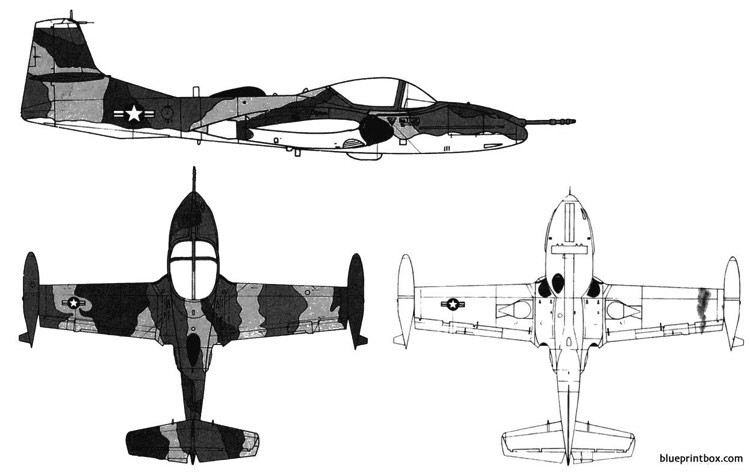
Performance
- Maximum speed: (816 km/h, )
- Cruise speed: (787 km/h, (max. cruise)
- Stall speed: 113 mph (182 km/h, 98 kn) at maximum landing weight, wheels and flaps down
- Combat range: 460 mi (740 km, 400 nmi) (with maximum payload)
- Ferry range: 1,012 mi (1,629 km, 879 nmi) (with 4× 100 US gal (83 imp gal; 380 L) drop tanks
- Service ceiling: 41,765 ft (12,730 m)
- Rate of climb: 6,990 ft/min (35.5 m/s)
Armament
-
- Guns:
- 1 × 7.62 mm (0.300 in) GAU-2B/A minigun in nose with 1500 rounds
- Provision for SUU-11/A gun pods under wings
- Hardpoints: 8 with a capacity of inner four: 860 lb (390 kg), two intermediate: 600 lb (270 kg), two outer: 500 lb (230 kg)
- Guns:
Links to Youtube & Others
Following the end of the conflict, the USAF's A-37Bs were transferred from the Tactical Air Command (TAC) to TAC-gained units in the Air National Guard and Air Force Reserve. The type was assigned to the FAC (Forward Air Control) role and given the designation OA-37B. The type were eventually phased out in the 1980s and 1990s, having been replaced in the FAC mission by the more formidable Fairchild Republic A-10 Thunderbolt II in American service.

Cessna A-37 Dragonfly
Super Tweet
Development of the type continue and in 1935 the Bf 108B appeared with the fin and rudder having undergone modifications.

Youtube Link
Model introduced in July 2014 for 2015 customer deliveries, powered by a 155 hp (116 kW) Continental CD-155 diesel engine installed by the factory under a supplemental type certificate.
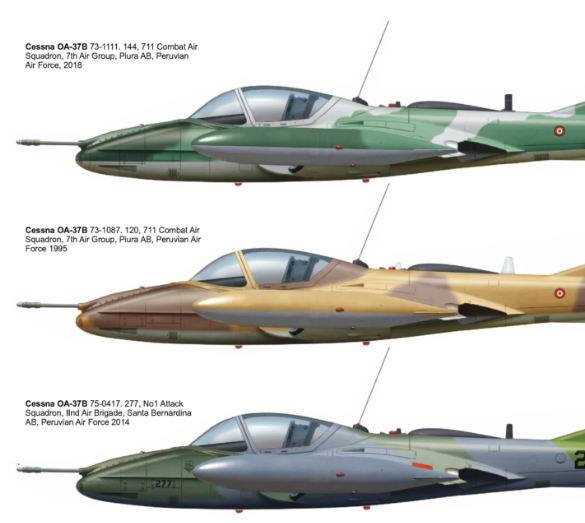
Read more in Cessna Textron
aircraft Corporation