Dassault Aviation SA
Dassault Mirage F1 "Vlamgat"
Manufactured 1966–1992
First flight 23 December 1966


Dassault Aviation SA Dassault Mirage F1
 |
|
| General information | |
|---|---|
| Type | Fighter aircraft |
| National origin | France |
| Manufacturer | Dassault Aviation |
| Status | In limited service |
| Primary users | French Air Force (historical)Iraqi Air Force (historical) Hellenic Air Force (historical) Spanish Air Force (historical) |
| Number built | 726 |
| History | |
| Manufactured | 1966–1992 |
| Introduction date | 1973; 52 years ago |
| First flight | 23 December 1966; 58 years ago |
| Developed from | Dassault Mirage III |
.
History Dassault Aviation SA
Dassault Mirage F1 "Vlamgat"
Manufactured 1966–1992
Introduction date 1973; 52 years ago
First flight 23 December 1966; 58 years ago

During the 1960s, Dassault commenced development of what would become the Mirage F1 as a private venture, alongside the larger Mirage F2. Work on the F1 eventually took precedence over the costlier F2, which was cancelled during the late 1960s. The French Air Force (Armée de l'Air) took interest in the fledgling fighter to meet its requirement for an all-weather interceptor aircraft. Accordingly, initial production units were equipped with the Thomson-CSF Cyrano IV monopulse radar.
The Mirage F1 emerged from a series of design studies performed by French aircraft manufacturer Dassault Aviation. Having originally sought to develop a larger swept wing derivative of the Mirage III, which became the Mirage F2, to serve as a vertical take-off and landing (VTOL) propulsion testbed akin to the Dassault Mirage IIIV, however, it was soon recognized that the emerging design could function as the basis for a competent fighter as well. Both the Mirage F2 and a smaller derivative, referred to the Mirage F3, received substantial attention from both Dassault and the French Air Force, the latter being interested in its adoption as a long-range fighter bomber as a stopgap measure prior to the adoption of the envisioned Anglo-French Variable Geometry (AFVG) strike aircraft..
Design

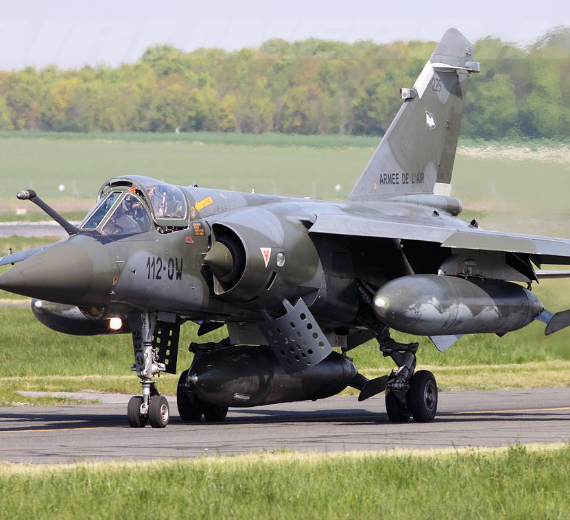
Mirage F1C of EC 2/30 Normandie-Niemen at the 1975 Paris Air Show. The Dassault Mirage F1 was a single-engine fighter aircraft, designed to function as both an interceptor aircraft and a ground attack platform. While officially developed for the French Air Force as an air defense aircraft, Dassault had placed considerable emphasis on developing the Mirage F1 for ground attack duties as a secondary role during its early design. Developed by the company to function as a successor to the successful Mirage III and Mirage 5 families, it drew heavily upon its predecessors as well, sharing the same fuselage as the Mirage III, while adopting a considerably different wing configuration.


0
KmCeiling
0
KmCombat RANGE
0
MachAircraft Speed
0
Max Crew
Photo Gallery
Dassault Aviation SA
Dassault Mirage F1 "Vlamgat"
Manufactured 1966–1992, Introduction date 1973
First flight 23 December 1966


Dassault Aviation SA, Dassault Mirage F1
General Info
-
-
- Crew: 1
- Length: 15.3 m (50 ft 2 in)
- Wingspan: 8.4 m (27 ft 7 in)
- Height: 4.5 m (14 ft 9 in)
- Wing area: 25 m2 (270 sq ft)
-
Powerplant
-
-
-
Empty weight: 7,400 kg
Gross weight: 10,900 kg (clean take-off weight) - Max takeoff weight: 16,200 kg
- Powerplant: 1 × SNECMA Atar 9K-50 afterburning turbojet engine, 49.03 kN (11,020 lbf) thrust dry, 70.6 kN (15,900 lbf) with afterburner
-
Empty weight: 7,400 kg
-

Performance
- Maximum speed: 2,338 km/h (1,453 mph, 1,262 kn) at 11,000 m (36,089 ft)
- Maximum speed: Mach 2.2
- Combat range: 425 km (264 mi, 229 nmi) hi-lo-hi at Mach 0.75/0.88 with 14 × 250 kg (551 lb) bombs
- Ferry range: 3,300 km (2,100 mi, 1,800 nmi) with maximum external fuel
- Endurance: 2 hr 15 min (combat air patrol, with 2 × Super 530 missiles and centreline drop tank)
- Service ceiling: 20,000 m
Related development
-
- Guns: 2× 30 mm (1.18 in) DEFA 553 cannons with 150 rounds per gun
- Hardpoints: 1 centreline pylon, four underwing and two wingtip pylons with a capacity of 6,300 kg (13,900 lb) (practical maximum load 4,000 kg (8,800 lb)),
Links to Youtube & Others
The French Dassault Mirage III and 5 delta-winged fighters were excellent aircraft and were built in large numbers, but their delta-wing configuration gave them almost inherent limitations, such as a long take-off run and limited agility. In the late 1960s, the Dassault company decided to follow the Mirage III/5 with a new technology fighter of more conventional configuration, the "Mirage F1", which proved successful, though not to the extent enjoyed by its delta-winged predecessors. This document provides a history and description of the Mirage F1.

Dassault Aviation SA Dassault Mirage F1
First flight in 1966 1974 : first delivery to the French Air Force 473 aircraft equipped the Air Forces of South Africa, Spain, Greece, Kuwait, Libya, Morocco, Ecuador, Iraq, Jordan and Qatar.

Youtube Link
Sir Charles Kingsford Smith's F.VIIB-3m Southern Cross was the first aircraft to cross the Pacific from the United States to Australia in June 1928,
Read more in Dassault Aviation SA
Dassault Mirage F1