de Havilland Aircraft Company
de Havilland DH.114 Heron
Introduction date 1950
First flight 10 May 1950


de Havilland
DH.114 Heron
.jpg) De Havilland DH.114 Heron 1 of British United Island Airways at London Gatwick Airport in April 1969 |
|
| General information | |
|---|---|
| Type | Airliner |
| National origin | United Kingdom |
| Manufacturer | de Havilland |
| Status | Retired |
| Primary users | Garuda Indonesian AirwaysSee Operators |
| Number built | 149 |
| History | |
| Introduction date | 1950 |
| First flight | 10 May 1950 |
| Developed from | de Havilland Dove |
| Variants | Saunders ST-27 |
|
|
|---|
.
History de Havilland Aircraft Company
de Havilland DH.114 Heron
Introduction date 1950
First flight 10 May 1950
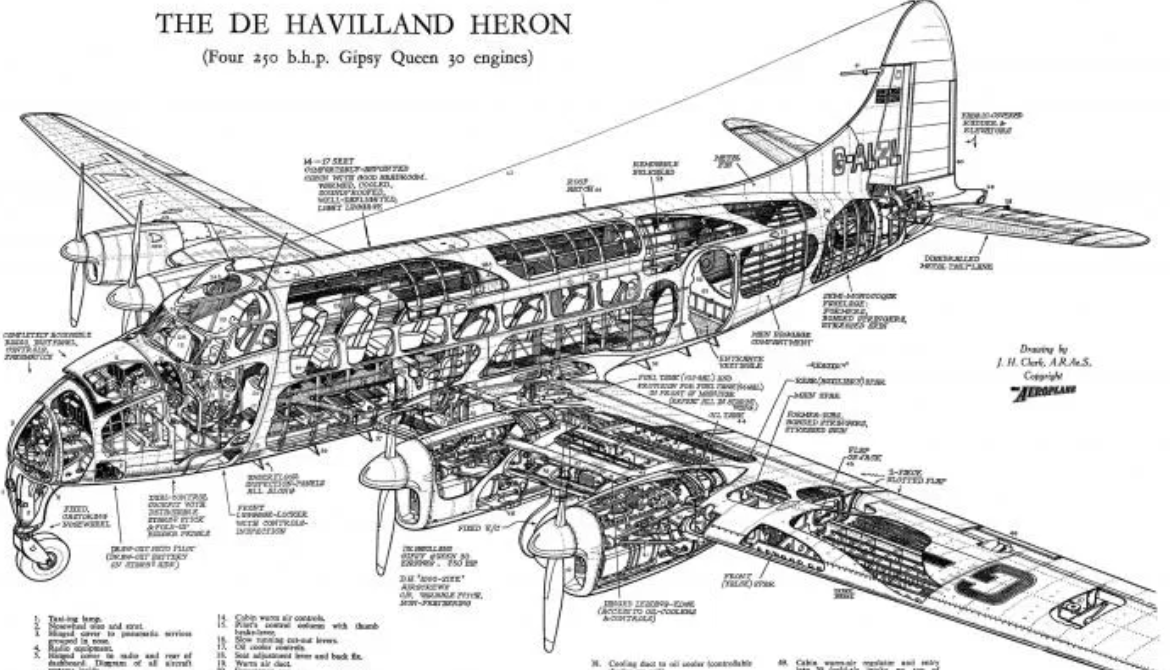
The de Havilland DH.114 Heron is a small propeller-driven British airliner that first flew on 10 May 1950. It was a development of the twin-engine de Havilland Dove, with a stretched fuselage and two more engines. It was designed as a rugged, conventional low-wing monoplane with tricycle undercarriage that could be used on regional and commuter routes. A total of 149 were built; it was also exported to about 30 countries. Herons later formed the basis for various conversions, such as the Riley Turbo Skyliner and the Saunders ST-27 and ST-28.
Design

In the closing stages of the Second World War, the aircraft manufacturer de Havilland began development of a new small twin-engined passenger aircraft, the DH 104 Dove, intended as a replacement for the earlier Dragon Rapide and which soon proved to be successful. As a further development, the company basically enlarged the Dove; the fuselage was lengthened to make room for more passengers or freight, and the wingspan was increased to make room for two more engines. The Heron was of all-metal construction, and was laid out as a conventional design; the resulting aircraft could use many of the parts originally designed for the Dove, thus simplifying logistics for airlines using both types..
Variants

-
Heron 1: Four-engined light transport aircraft. Fitted with fixed landing gear.
- Heron 1B: This model had an increased takeoff weight of 13,000 pounds (5,900 kg).
- Heron 2: Four-engined light transport aircraft. Fitted with retractable landing gear.
- Heron 2A: This designation was given to a single Heron 2, which was sold to a civil customer in the US.
- Heron 2B: This model had the same increased takeoff weight as the Heron 1B.
- Heron 2C: Redesignation of the Heron 2Bs, which could be fitted with optional fully feathering propellers.
- Heron 2D: Four-engined light transport aircraft. This model had an increased takeoff weight of 13,500 pounds (6,120 kg).
- Heron 2E: VIP transport aircraft. One custom-built aircraft.
0
KmCeiling
0
KmCombat RANGE
0
Km/hAircraft Speed
0
Max Crew
Photo Gallery
de Havilland Aircraft Company
de Havilland DH.114 Heron
Introduction date 1950
First flight 10 May 1950




de Havilland Aircraft Company de Havilland DH.114 Heron Introduction date 1950 First flight 10 May 1950
General Info
-
-
-
- Crew: Two
- Capacity: 14 passengers
- Length: 48 ft 6 in (14.78 m)
- Wingspan: 71 ft 6 in (21.79 m)
- Height: 15 ft 7 in (4.75 m)
-
-
Powerplant
-
-
- Empty weight: 8,150 lb (3,697 kg)
- Max takeoff weight: 13,500 lb (6,123 kg)
- Fuel capacity: 412 imp gal (495 US gal; 1,870 L)
- Powerplant: 4 × de Havilland Gipsy Queen 30 Mk.2 6-cylinder inverted inline air-cooled piston engine, 250 hp (190 kW) each
-

Performance
-
- Cruise speed:(295 km/h, 159 kn)
- Range: (1,473 km, 795 nmi)
- Service ceiling:(5,600 m)
- Rate of climb: 1,140 ft/min (5.8 m/s)
- Takeoff distance to 50 ft (15 m): 2,425 ft (739 m)
- Landing distance from 50 ft (15 m): 2,065 ft (629 m)
Links to Youtube & Others
The first Heron, Series 1A suffered deficiencies, as NAC soon discovered. First, the aircraft was generally underpowered. Its quite heavy engines (weighing about 490 pounds (220 kg) each), had an output of only 250 hp (190 kW) each

de Havilland
DH.114 Heron
One U.S. airline that carried out Riley-type conversions at their Opa Locka Airport, Florida, engineering facility was Prinair.


Read more in Hawker Siddeley Aircraft was a British aircraft manufacturer.
.


.svg.png)