
Curtiss Wright
P-40 Kittyhawk
First Flight 14 October 1938 Produced 1939–1944


Curtiss Wright
P-40 Kittyhawk
Role Fighter aircraft
National origin United States
Manufacturer Curtiss-Wright
First flight 14 October 1938
Introduction 1939
Retired Brazilian Air Force (1958)
Primary users United States Army Air Forces
Royal Air Force
Royal Australian Air Force
Royal Canadian Air Force
Produced 1939–1944
Number built 13,738
Developed from Curtiss P-36 Hawk
Variants Curtiss XP-46
.
History Curtiss Wright
P-40 Kittyhawk
First Flight 14 October 1938 Produced 1939–1944
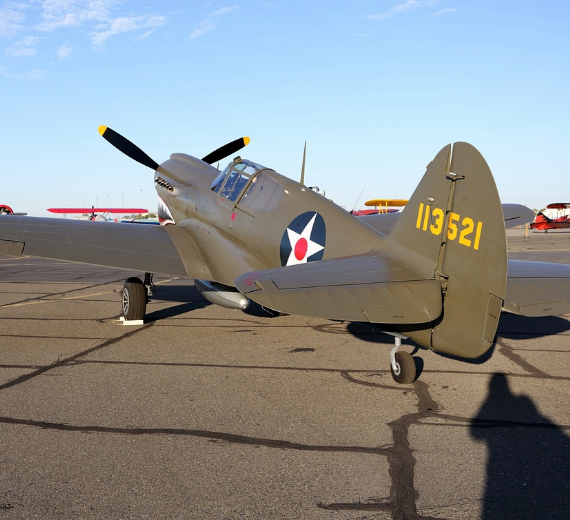
The Curtiss P-40 Warhawk is an American single-engined, single-seat, all-metal fighter and ground-attack aircraft that first flew in 1938. The P-40 design was a modification of the previous Curtiss P-36 Hawk which reduced development time and enabled a rapid entry into production and operational service. The Warhawk was used by most Allied powers during World War II, and remained in frontline service until the end of the war. It was the third most-produced American fighter of World War II, after the P-51 and P-47.
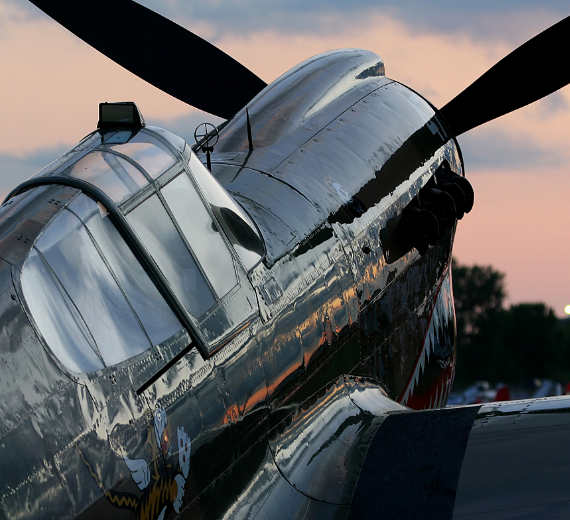
P-40 Warhawk was the name the United States Army Air Corps gave the plane, and after June 1941, the USAAF adopted the name for all models, making it the official name in the U.S. for all P-40s. The British Commonwealth and Soviet air forces used the name Tomahawk for models equivalent to the original P-40, P-40B, and P-40C, and the name Kittyhawk for models equivalent to the P-40D and all later variants. P-40s first saw combat with the British Commonwealth squadrons of the Desert Air Force in the Middle East and North African campaigns, during June 1941.[4][5] No. 112 Squadron Royal Air Force, was among the first to operate Tomahawks in North Africa and the unit was the first Allied military aviation unit to feature the "shark mouth" logo,[6][7] copying similar markings on some Luftwaffe Messerschmitt Bf 110 twin-engine fighters
Performance characteristics
.jpg)
0
KmCeiling
0
KmCombat RANGE
0
Km/hAircraft Speed
0
Max Crew
Photo Gallery
Curtiss Wright
P-40 Kittyhawk
First Flight 14 October 1938 Produced 1939–1944


Curtiss Wright P-40 Kittyhawk
General Info
-
-
- Crew: One
- Length: 31 ft 8.5 in (9.665 m)
- Wingspan: 37 ft 3.5 in (11.367 m)
- Height: 10 ft 8 in (3.25 m)
- Wing area: 236 sq ft (21.9 m2)
-
Powerplant
-
-
- Empty weight: 5,922 lb (2,686 kg)
- Gross weight: 8,515 lb (3,862 kg)
- Powerplant: 1 × Allison V-1710-39 V-12 liquid-cooled piston engine, 1,240 hp (920 kW)
- Propellers: 3-bladed Curtiss-Wright electric constant-speed propeller
-

Performance
- Maximum speed: 334 mph (538 km/h, 290 kn) at 15,000 ft (4,600 m)
- Cruise speed: 308 mph (496 km/h,
- Range: 716 mi (1,152 km, 622 nmi) at 70% power
- Service ceiling: (8,900 m)
- Time to altitude: (4,600 m) in 6 minutes 15 seconds
- Wing loading: 35.1 lb/sq ft (171 kg/m2)
Armament
- Guns: 6 × 0.5 in (12.7 mm) M2 Browning machine guns in the wings
- Bombs: 250 to 1,000 lb (110 to 450 kg) bombs to a total of 2,000 lb (910 kg) on hardpoints under the fuselage and two underwing
.
Links to Youtube & Others
The MB-339 was developed during the 1970s in response to an Italian Air Force requirement that sought a replacement for the service's existing fleet of Aermacchi MB-326s.

Curtiss Wright
P-40 Kittyhawk
The P-40 was the United States' best fighter available in large numbers when World War II began.
Read more in Curtiss Wright
.