
Bombardier Aviation
Canadair CL-415 (Super Scooper)
Manufactured CL-415: 1993–2015 / DHC-515: 2022–present
Introduction date 1994


Canadair
CL-415 (Super Scooper)
.jpg) |
|
| General information | |
|---|---|
| Type | Firefighting aircraft |
| Manufacturer | Canadair Bombardier Aerospace De Havilland Canada |
| Status | Active service |
| Primary users | Vigili del Fuoco (Italy)Sécurité Civile (France) Hellenic Air Force (Greece) Quebec Service aérien gouvernemental |
| Number built | 95 |
| History | |
| Manufactured | CL-415: 1993–2015 / DHC-515: 2022–present |
| Introduction date | 1994 |
| First flight | 6 December 1993 |
| Developed from | Canadair CL-215 |
.
History Bombardier Aviation
Canadair CL-415 (Super Scooper)
Manufactured CL-415: 1993–2015 / DHC-515: 2022–present
Introduction date 1994

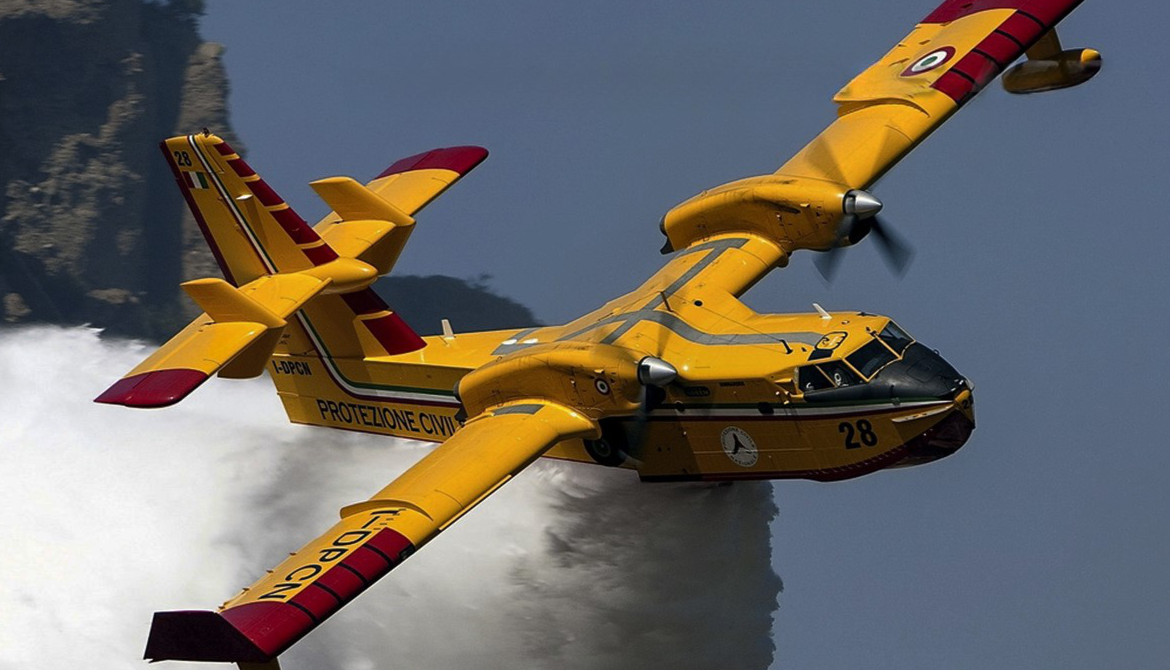
The Canadair CL-415 (Super Scooper,[2] later Bombardier 415) and the De Havilland Canada DHC-515 are a series of amphibious aircraft built originally by Canadair and subsequently by Bombardier and Viking Air, and De Havilland Canada. The CL-415 is based on the Canadair CL-215 and is designed specifically for aerial firefighting; it can perform various other roles, such as search and rescue and utility transport.
Development of the CL-415 began in the early 1990s, shortly after the success of the CL-215T retrofit programme had proven a viable demand for a turboprop-powered model of the original CL-215. Entering production in 2003, in addition to its new engines, the aircraft featured numerous modernisation efforts and advances over the CL-215, particularly in terms of its cockpit and aerodynamics, to yield improved performance. By the time the programme's production phase had begun, it was owned by Bombardier, who continued production up until 2015. In October 2016, the CL-415 programme was acquired by Viking Air, aiming to produce an updated CL-515 since renamed the DHC-515 Firefighter, and to be produced in Calgary, Alberta, by De Havilland Canada
Design
.jpg)
.JPG)
The CL-415 has an updated cockpit, aerodynamics enhancements and changes to the water-release system as well, creating a modern firefighting amphibious flying boat for use in detecting and suppressing forest fires. Compared to the CL-215, the CL-415 has increased operating weight and speed, yielding improved productivity and performance. Due to the increased power of its pair of Pratt & Whitney Canada PW123AF turboprop engines, each capable of generating up to 1,775 kW of thrust, these are located closer to the fuselage in comparison to the CL-215's arrangement. While this repositioning would typically reduce lateral stability on its own, this is rectified via the addition of an inverted fixed leading edge slat forward of the righthand horizontal stabiliser. Furthermore, winglets have been adopted on this model for the purpose of improving directional stability
0
KmCeiling
0
KmCombat RANGE
0
Km/hAircraft Speed
0
Max Crew
Photo Gallery
Bombardier Aviation
Canadair CL-415 (Super Scooper)


Bombardier Aviation
Canadair CL-415 (Super Scooper)
General Info
-
-
- Crew: 2
- Capacity: 6,137 L (1,350 imp gal; 1,621 US gal) (waterbombing), up to 18 paratroops, up to 2,903 kg of cargo
- Length: 20.4 m (66 ft 11 in)
- Wingspan: 28.38 m (93.11 ft)
- Height: 9.01 m (29.55 ft)
- Wing area: 100 m2 (1,080 sq ft)
-
Powerplant
-
- Empty weight: 13,608 kg (30,000 lb)
- Gross weight: 21,319 kg (47,000 lb) Maximum After-scooping Weight
- Max takeoff weight: 19,890 kg (43,850 lb) Firefighting, Land
- Fuel capacity: 4,650 kg (10,250 lb) 5812 L ( 1535 US Gal; 1278 imp Gal)
- Cabin volume: 35.6 m3 (1,260 cu ft)
- Powerplant: 2 × Pratt & Whitney Canada PW123AF turboprop, 1,775 kW (2,380 hp) each ISA+20 °C Flat rated
-

Performance
- Maximum speed: 359 km/h Max Cruise
- Cruise speed: 333 km/h Normal Cruise
- Stall speed: 126 km/h (78 mph, 68 kn) MLW, Landing Configuration
- Ferry range: 2,427 km (1,508 mi, 1,310 nmi) 278 km/h Long Range Cruise
- Endurance: 3 hours at from base
- g limits: +3.25−1.0 g
.
Links to Youtube & Others
During December 2018, a full-flight CL-415 simulator, capable of simulating water scoop and bombing operations, received European Aviation Safety Agency (EASA) certification. Prior to this, pilot training had typically involved live flying of the aircraft.

Bombardier Aviation
CL-415 Super Scooper
Derived from its predecessor's nickname, the aircraft has acquired the name "Super Scooper"

Youtube Link
By 1999, a total of 51 orders had been secured for the type; operators have reportedly predominantly used the CL-415 for firefighting and maritime search and rescue purposes

Read more in Canadair Aerospace
.


